
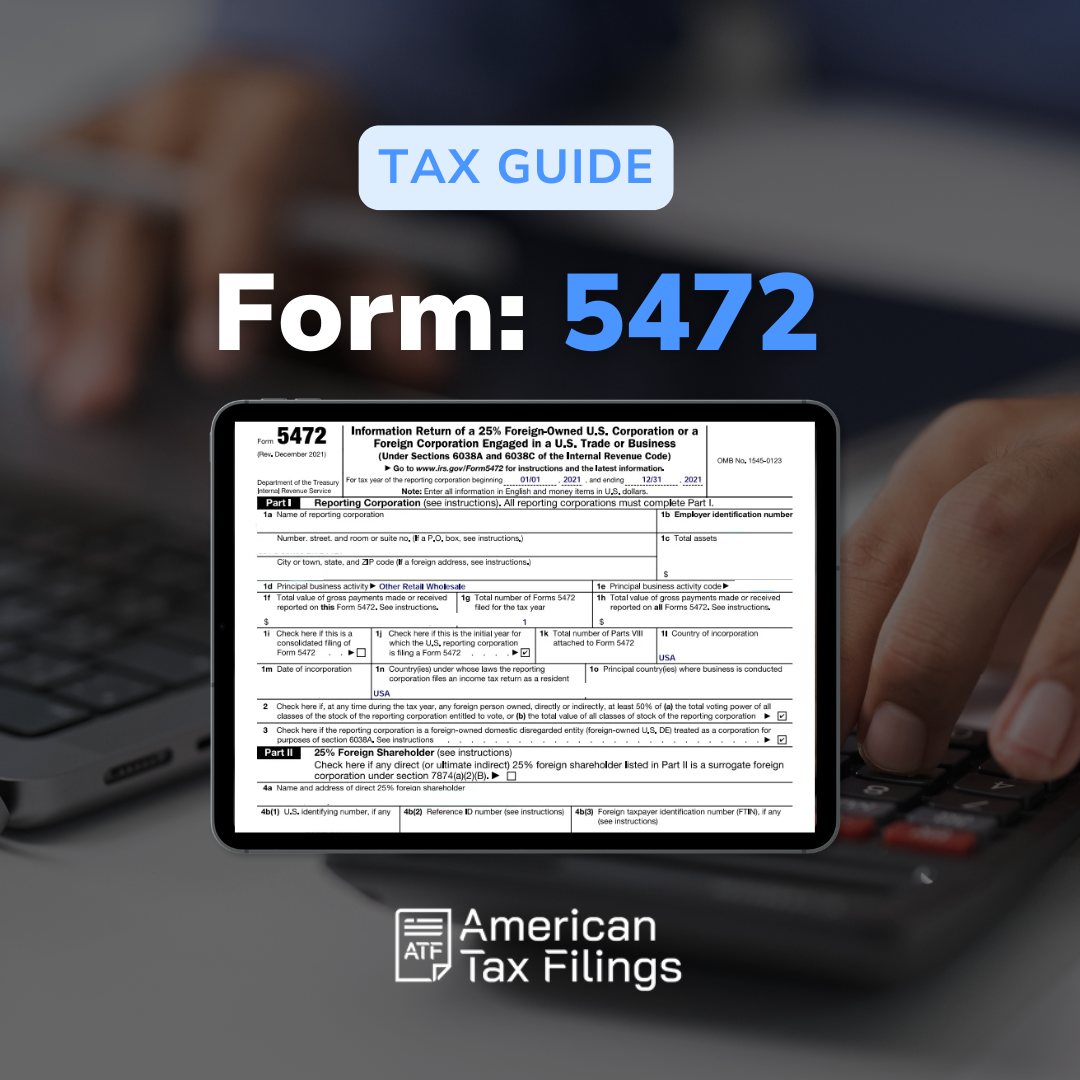
If you’re a foreign individual who owns a US single-member LLC (SMLLC), there’s an IRS reporting requirement that often flies under the radar for business owners — Form 5472. It’s not a tax return but an information return. Missing it can lead to steep penalties, though the IRS may reduce or waive them if you can show you had a valid reason for filing late.
In this guide, we’ll cover:
- What Form 5472 is and who must file
- When you do and don’t need to file
- How the penalty works
- What counts as “reasonable cause” for penalty relief
- Why relying solely on a tax professional may not save you
- How to avoid future penalties

What is Form 5472?
Form 5472 must be filed by certain US and foreign corporations that have reportable transactions with foreign owners or related parties. You are considered a “reporting corporation” if you are:
- A US corporation with at least 25% foreign ownership (this includes a foreign-owned US disregarded entity, like a single-member LLC), or
- A foreign corporation engaged in a trade or business in the United States
Since 2017, foreign-owned SMLLCs have been treated as corporations for the purpose of filing Form 5472, and must also submit a pro forma Form 1120 along with it.
The form is used to report certain transactions between the reporting corporation and its foreign owner or related parties.
Common examples include:
- Contributions of money or property from the foreign owner
- Distributions to the foreign owner
- Loans to or from the foreign owner (even interest-free loans)
- Purchases, sales, or other transfers involving the owner or related parties
Most small foreign business owners who encounter Form 5472 fall into the first category (foreign-owned US entities). The second category mainly affects foreign corporations that are already filing Form 1120-F.
Do You Always Need to File Form 5472?
Not always — but the rules are strict.
- Year of formation: The creation of a foreign-owned US disregarded entity is generally considered a reportable transaction because it usually involves a capital contribution from the foreign owner. Even if no money moved in or out afterward, you’ll almost always need to file Form 5472 for the year the LLC was formed
- Later years with no reportable transactions: If your LLC had absolutely no reportable transactions with its foreign owner or related parties for the entire year, you generally don’t have to file for that year.
Other exceptions that apply to corporations (like the de minimis transaction rules) do not apply to foreign-owned SMLLCs.
How the Form 5472 Penalty Works
If you file Form 5472 late or submit an incomplete form, the IRS can immediately assess an initial $25,000 penalty for that tax year. If you never file, you don’t get the protection of the statute of limitations — meaning the IRS can assess penalties for all open years, no matter how far back they go.
Once the IRS sends you a notice about the failure, you have 90 days to fix it. If you don’t, the penalty increases by an additional $25,000 for each related party for every 30-day period (or part of a period) that the failure continues. There’s also a separate $25,000 penalty for failing to maintain the required records.
In practice, when a late Form 5472 is filed, the IRS almost always assesses the $25,000 initial penalty automatically. To have it removed, you must respond with a detailed “reasonable cause” explanation and the IRS must agree to waive it.
If you need help preparing Form 5472 correctly, our team can ensure compliance and reduce the risk of repeated penalties.
Form 5472 Penalty Relief: What Works and What Doesn’t
The IRS can waive penalties if you can show you acted with ordinary business care and prudence and that the failure was due to circumstances beyond your control. Treasury regulations for Form 5472 expressly allow reasonable-cause relief.
Examples that may work:
- Honest misunderstanding of fact or law
- Inability to obtain records despite efforts
- Death, illness, or unavoidable absence of the responsible person
- Fire, natural disaster, or similar events
- Recent change in the law
- Reasonable reliance on advice from a competent tax professional (when all facts were provided)
- Substantial compliance with only minor, inadvertent omissions
Arguments that rarely work:
- “I didn’t know the rule”
- “I was too busy”
- “My CPA forgot to file” (without showing reasonable reliance and due diligence)
- Financial hardship
In certain tax cases, courts have granted penalty relief when the taxpayer showed reasonable cause based on good-faith reliance on a competent CPA to whom all relevant facts were provided. In other cases, relief was denied because the taxpayer failed to give the advisor complete and accurate information.
Why Relying on a Tax Professional Alone Often Isn’t Enough
The IRS holds you — not your accountant — ultimately responsible for filing Form 5472. You can rely on a professional’s advice about whether the form is required, but simply assuming they filed it without confirming can cost you.
If you do rely on a tax professional, make sure to:
- Provide all relevant facts about your ownership, transactions, and entity structure
- Act in good faith and promptly respond to any requests for information
- Follow up to confirm the form was actually filed
Avoiding the Problem Next Year
The easiest way to deal with a Form 5472 penalty is to never get one in the first place. A few simple steps can keep you compliant and penalty-free:
- Confirm early in the year whether you need to file Form 5472
- Mark the due date — April 15, or the extended date if you file Form 7004
- Work with professionals experienced in international information returns, like our Form 5472 filing service
- Maintain complete records of all reportable transactions until the statute of limitations closes
Bottom Line
Late or missed Form 5472 filings can lead to steep, recurring penalties and keep your tax year open indefinitely. While the IRS may waive penalties in certain cases, that decision is entirely theirs.
We help foreign-owned LLCs stay compliant by preparing and filing Form 5472 accurately and on time. If your filing is late, we can complete the required forms and share our professional insight.
Email us at contact@americantaxfilings.com to get your Form 5472 filed correctly and protect your business from unnecessary risks.