
Expert Tax Filing, Without the Stress
Simplified Tax Filing for Americans Abroad
Our Expat Package provides a straightforward, comprehensive U.S. tax filing solution for Americans living abroad. We ensure full compliance with IRS international reporting rules, maximizing tax savings through available exclusions and credits.

What’s Included in the
Expat Package
| Form Schedule | Description | Included |
|---|---|---|
| FinCEN Form 114 (FBAR) | Reporting of unlimited foreign bank and financial accounts | Unlimited Accounts |
| Form 1040-ES | Estimated Tax Calculation and Payment Vouchers (if applicable) | |
| Form 1040 | U.S. Individual Income Tax Return | |
| Schedule 1 | Additional Income and Adjustments to Income | |
| Schedule 2 | Additional Taxes | |
| Schedule 3 | Additional Credits and Payments | |
| Schedule A | Itemized Deductions | |
| Schedule B | Interest and Ordinary Dividends | |
| Schedule C | Profit or Loss from Business (self-employment or single-member LLC) | First business included (each additional business at extra cost) |
| Schedule D | Capital Gains and Losses | Unlimited Transactions |
| Form 8949 | Sales and Other Dispositions of Capital Assets | |
| Form 1116 | Foreign Tax Credit | |
| Form 2441 | Child and Dependent Care Expenses (if applicable) | |
| Form 2555 | Foreign Earned Income Exclusion | |
| Form 5695 | Residential Energy Credits (if applicable) | |
| Form 6251 | Alternative Minimum Tax – Individuals (if applicable) | |
| Form 8582 | Passive Activity Loss Limitations | |
| Schedule 8812 | Credits for Qualifying Children and Other Dependents | |
| Form 8995-A | Qualified Business Income Deduction (if applicable) | |
| Form 8960 | Net Investment Income Tax (if applicable) | |
| Form 8938 | Reporting of unlimited specified foreign financial accounts | Unlimited Accounts |
| Federal Extension | Automatic extension filing to October 15 | |
| E-Filing | Secure electronic filing of your tax returns |
Add-ons
| Form Schedule | Description | Included |
|---|---|---|
| Schedule C | Additional Profit or Loss from Business (self-employment or single-member LLC) | $100 |
| Schedule E | Rental property or K-1 (each) | $100 |
| State Income Tax Return | State income tax return (each) | $175 |
| Form 8621 | Information Return by a Shareholder of a Passive Foreign Investment Company | $85 each |
| Form 3520 | Annual Return To Report Transactions With Foreign Trusts and Receipt of Certain Foreign Gifts | $250 |
| Form 3520-A | Annual Information Return of Foreign Trust With a U.S. Owner | $350 |
| Form 5471 | Information Return of U.S. Persons With Respect To Certain Foreign Corporations | $600 |
| Form 8858 | Information Return of U.S. Persons With Respect to Foreign Disregarded Entities and Foreign Branches | $400 |
| Form 8865 | Return of U.S. Persons With Respect to Certain Foreign Partnerships | $600 |
| Form 709 | U.S. Gift Tax Return | $350 |
| Form W-7 | Application for IRS Individual Taxpayer Identification Number | $250 |
| Form 1040-X | Amended U.S. Individual Income Tax Return | Request custom quote |
Why Choose the Expat Package?
- Flat-fee pricing — no hourly rates or surprise charges
- Tailored for expats — covers the most common U.S. tax needs abroad, including FBAR and Form 2555
- Trusted expertise — handled by IRS-licensed Enrolled Agents with deep experience in expat returns
- Clarity on extras — all included forms are listed upfront; we’ll flag any special reporting before we begin
- Support for complex cases — including PFICs, foreign pensions, foreign trusts, and foreign corporations when needed
No More Tax Headaches:
Say Goodbye to These Common Problems
Problem

Many expats aren’t sure which U.S. forms are required or how their foreign income, pensions, or accounts affect their U.S. tax return.

Expats worry about being taxed by both their country of residence and the U.S.


Solution

We handle all required disclosures—Form 2555 (Foreign Earned Income Exclusion), Form 1116 (Foreign Tax Credit), Form 8938, FBARs, and more—so you stay fully compliant without the guesswork.

We apply the appropriate exclusions and credits to help reduce or eliminate double taxation—maximizing savings and minimizing IRS risk.

We flag any extra forms that might apply and explain what’s needed. If anything falls outside the standard package, we’ll walk you through your options—clearly and up front.
Problem
Many expats aren’t sure which U.S. forms are required or how their foreign income, pensions, or accounts affect their U.S. tax return.
Solution
We handle all required disclosures—Form 2555 (Foreign Earned Income Exclusion), Form 1116 (Foreign Tax Credit), Form 8938, FBARs, and more—so you stay fully compliant without the guesswork.
Problem
Expats often don’t know about additional international reporting requirements until it’s too late.
Solution
We flag any extra forms that might apply and explain what’s needed. If anything falls outside the standard package, we’ll walk you through your options—clearly and up front.
Problem
Expats worry about being taxed by both their country of residence and the U.S.
Solution
We apply the appropriate exclusions and credits to help reduce or eliminate double taxation—maximizing savings and minimizing IRS risk.
How We Work?

Sign Up
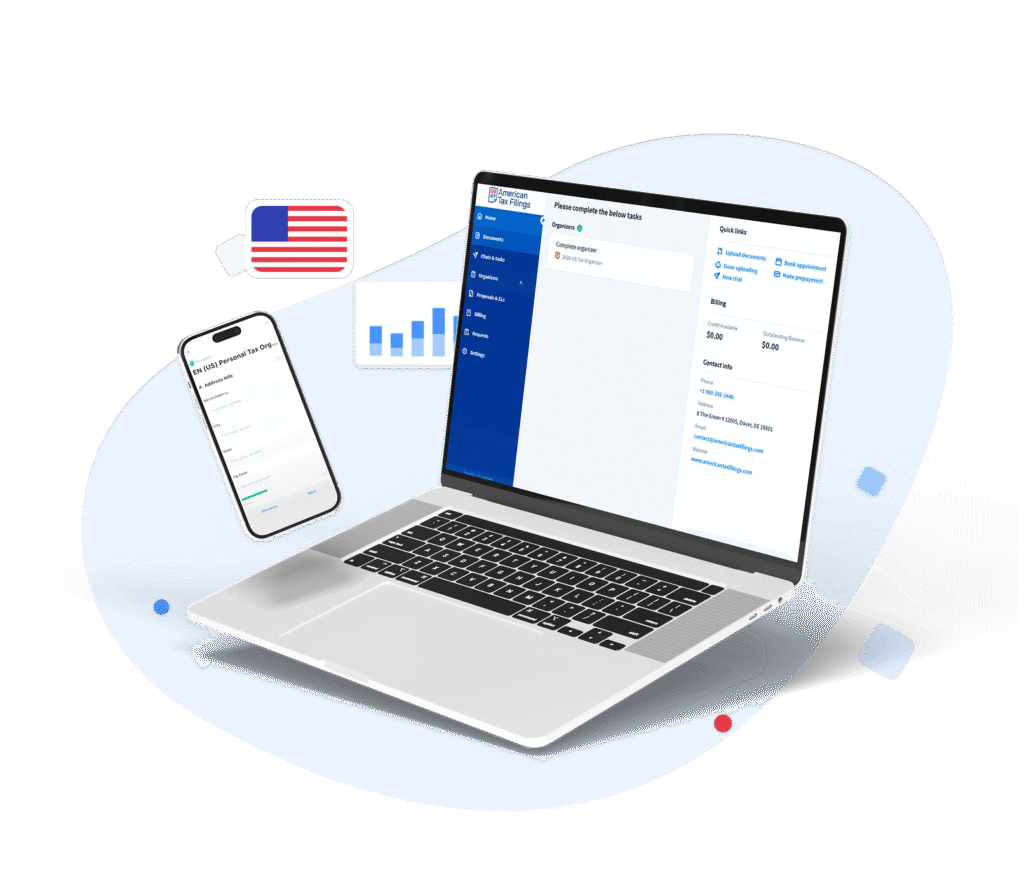
Join our secure portal and complete a short intake form. We’ll send your engagement letter with clear pricing before we begin.

Share Your Details

Review & File
We’ll prepare and review your return. You approve it, and we e-file with the IRS and/or state as required.
Expert Tax Filing, Without the Stress
Frequently Asked Questions
What makes your Expat Package different from others?
Our Expat Package includes both Form 114 (FBAR) and Form 8938 with unlimited accounts reported, which many other firms charge separately for. It also covers the most common forms and schedules required for U.S. citizens living abroad, giving you comprehensive service at a competitive price. See the full list of forms included.
When is the deadline to file a U.S. tax return if I live abroad?
U.S. citizens and residents abroad typically receive an automatic extension to June 15. However, any taxes owed are still due by April 15, and interest accrues from that date. Our package includes an extension to October 15 to protect you from late filing penalties if you need more time beyond June 15.
What should I consider when moving abroad to qualify for the foreign earned income exclusion?
To qualify, you must meet the Bona Fide Residence (BFR) or Physical Presence (PPT) Test. Both tests have specific time and residency requirements. If you’re in the process of meeting these criteria, you may need to file an extension to give yourself more time before filing your tax return.
What’s the difference between the Bona Fide Residence (BFR) Test and the Physical Presence (PPT) Test?
BFR: Requires you to live abroad for an uninterrupted period, including a full tax year (Jan 1–Dec 31), with the intention of making a home there.
PPT: Requires you to be physically present in a foreign country for at least 330 days during any 12-month period.
Both tests allow you to qualify for exclusions, but the BFR is based on your intent and residence, while the PPT is based on the number of days abroad.
What is the foreign earned income exclusion limit for 2025 and 2026?
For tax year 2025, the maximum Foreign Earned Income Exclusion is $130,000 per qualifying person. For tax year 2026, it is $132,900 per qualifying person. This applies to earned income only (such as wages or self-employment income). Investment income and other unearned income are not eligible. If you qualify for only part of the year, the maximum is prorated based on your qualifying days.
Can I exclude both self-employment and wage income?
Yes, you can exclude both types of income under the Foreign Earned Income Exclusion (FEIE), which reduces your U.S. income tax. However, if you’re self-employed and reside in a country with no totalization agreement with the U.S., you may still be liable for the full 15.3% self-employment tax (Social Security and Medicare), even if your income qualifies for the FEIE.
Do I still need to file if my foreign income qualifies for the exclusion?
Yes, U.S. tax law requires all citizens and residents to file a return if their gross income exceeds certain thresholds—even if that income is excluded under the foreign earned income exclusion. Filing ensures you formally claim the exclusion and stay compliant with U.S. tax laws.
What happens if I return to the U.S. early and can’t claim the exclusion?
Returning early means you may lose the exclusion. You’ll need to report your worldwide income and pay taxes owed by the original due date. If you paid taxes abroad, you may be eligible for foreign tax credits to offset your U.S. tax liability.
What is the Foreign Housing Exclusion?
In addition to the foreign earned income exclusion, you may exclude certain housing expenses, such as rent or utilities, that exceed a base amount set by the IRS. The exact exclusion depends on your location and the cost of housing, and the IRS provides specific guidelines on how to calculate it.
What is the Foreign Tax Credit and how does it work?
The Foreign Tax Credit allows you to reduce your U.S. tax liability by the amount of taxes you paid to a foreign country. This helps prevent double taxation. Unlike the foreign earned income exclusion, which excludes income from U.S. tax, the credit reduces your tax owed dollar-for-dollar, but you can’t use both the credit and exclusion for the same income. We can help you optimize your tax position by determining which option—or combination of options—provides the greatest benefit based on your specific income sources and foreign tax rates.
Do I need to make estimated tax payments if I’m living abroad and qualify for the foreign earned income exclusion?
You may need to make estimated tax payments in certain situations, such as:
- If your foreign income exceeds the exclusion and your foreign tax rate is lower than the U.S. rate.
- If you have U.S.-source investment income.
- If you’re self-employed and live in a country with no totalization agreement with the U.S., in which case you may owe self-employment tax (15.3%).
- If your income exceeds NIIT thresholds ($200,000 for single filers, $250,000 for joint filers, $125,000 for married filing separately), you may owe the 3.8% Net Investment Income Tax.
Estimated payments are due quarterly, with the first installment due April 15.
Can I file as Head of Household if married to a nonresident alien?
Yes, you can file as Head of Household if you meet the requirements, including maintaining a household for a qualifying child or relative. You can also choose to treat your nonresident alien spouse as a U.S. resident for tax purposes and file jointly, but this requires reporting their worldwide income.
Do I need to report foreign bank accounts?
Yes, if you have foreign bank accounts with an aggregate balance over $10,000 at any point in the year, you must file an FBAR (Foreign Bank Account Report) with the Financial Crimes Enforcement Network (FinCEN). Failing to report can result in significant penalties. We include FBAR filing with unlimited accounts in this package.
Can I pay my U.S. taxes in foreign currency?
No, the IRS only accepts payments in U.S. dollars. If you need to pay taxes but have foreign currency, you’ll need to convert it to U.S. dollars using the exchange rate for the day of payment.
Do US citizens living abroad need to file US taxes?
Yes. US citizens are required to file US tax returns even when living overseas. Our Expat Package helps simplify this process and ensures compliance with IRS requirements.
Expat Tax Filing Package
Our Expat Package is designed for US citizens living abroad who need to file their US tax returns and stay compliant with IRS requirements.
We assist expatriates with:
- Filing US taxes while living overseas
- Reporting foreign income and bank accounts
- Understanding expat tax obligations
- Guidance from experienced expat tax advisors
Do US citizens living abroad need to file US taxes?
Yes. US citizens are required to file US tax returns even when living overseas. Our Expat Package helps simplify this process and ensures compliance with IRS requirements.
Ready to File Your U.S. Taxes from Abroad? Get started with the Expat Package from American Tax Filings
Take control of your U.S. tax filing while living overseas. Our expert-led, flat-fee service makes expat compliance simple, secure, and affordable.